Saturday, April 28, 2018

The Four Factions of American Politics

I was able to take advantage of my 13 hour flight from Detroit to Tokyo without Internet access (I decided to go off the grid -- WiFi was available for $30) to contemplate the current state of the nation. Below are the feuits of this contemplation. Please note that I could be and probably am wrong about numerous things, and probably am being unfair if not bigoted. Opinions are like that, and these are my opinions. Everyone is entitled to his or her own opinions, and I am sure that people who I refer to below with derogatory terms have good reasons for having different perspectives. It's okay, and quite natural, to disagree. My purpose in this name calling is to encourage us, as a nation, to act constructively and I hope that any responses are made in that spirit.

At the risk of excessive verbosity and losing my audience before I get around to expressing my opinions, I would like to expand upon why I feel the need to write yet another provocative political screed that risks generating more heat than light. I feel that 3 of the 4 political factions are misguided and hope by this writing to persuade those who may not currently be in any faction to consider my perspective. Of course, most of us probably don't fall neatly in any of my 4 categories, so I'm hoping than most of us will be able to relate to my categorization without necessarily agreeing with my opinions. I don't really expect to convert people who are firmly in the camp of another faction. In other words I'm not trying to pick a fight, but rather am addressing this to people who already see certain controversial assumptions I make as plausible. Without further ado, then...

There are four active and influential factions in American politics today:
  1. Airheads -- Trump and his supporters -- generally opportunists without political convictions. Trump is a demagogue, defined by the ancient Greeks as a politician with no core principles other than self-aggrandizement. 
  2. Warmongers -- The anti-Trump neocons who are successfully pushing the U.S. into a new cold war and hot wars in the Middle East. 
  3. Bad Losers -- The Clinton Democrats who are mad at the progressives and the airheads, and so are making common cause with the warmongers. 
  4. Progressives -- The Sanders faction of the left wing which is making progress in moving public opinion in the direction of democratic socialism.
(Libertarians and social conservatives are additional groups that I will ignore here. These groups are unfocused and demoralized at the present time since Republicans have been taken over by the airheads and warmongers. This situation predates the Trump presidency by a considerable time.  Witness the warmongering presidency of George W. Bush, and the succession of oddball candidates that populated the Republican presidential primaries in 2008, 2012, and 2016.)

The airheads and bad losers are going nowhere, almost by definition. Thus, the crucial confrontation is between the warmongers and progressives. Ultimately, the warmongers will lose as:
  1. They are corrupt.
    and/or
  2. They are deluded.
(Note that I'm not a pacifist. There may indeed be a time for war as well as a time for peace. I just don't think our current militant faction is on solid ground.)

However, there will be a lot of bloodshed before they are defeated. The best case scenario is that they make a huge and obvious mistake. Here a couple of examples that come to mind:
  1. Evidence emerges that the Syrian gas attacks were staged, and thus the U.S. and western intelligence was wrong again (as in Iraq). 
  2. Evidence emerges that the Skripal poisoning was not the work of the Russian government, and thus the kneejerk reaction of the U.K., the U.S., and our allies to punish Russia was misguided. 
  3. The Trump-Russia collusion investigation being pursued by the FBI goes nowhere and, in fact, reveals Democratic blunders and corruption, in addition to Republican blunders and corruption. We've already seen some of that with Clinton associate Tony Podesta.
Unfortunately, the best case that something such as one of the above brings down the warmongers is fairly unlikely for the following reasons:
  1. The warmongers and the bad losers have a lock on the mainstream media and, with the assistance of and/ or under the direction of the intelligence agencies, could whitewash the mistakes. The bad losers / formerly mainstream Democrats are now willing to give the intelligence agencies the benefit of the doubt in terms of accepting whatever the spies say. This is not so far fetched as that's how we got into both the Vietnam and Iraq II wars.
  2. The warmongers may have the truth on their side in some or all of the events listed above (Syrian chemcial attacks, Skripal poisoning, collusion with Trump). I think it likely that there is at lot that we have not been told about these events which would make the case for war less convincing, but who am I to argue with the intelligence agencies? After all, they have the billion dollar budgets to figure out and report what is going on.
So the more likely case in my opinion is that the warmongers lose in longer run, for the following reasons:

1. The wars will go badly.  As the world's #1 superpower, the U.S. has more to lose than to gain:  
    1. Regime change in Syria, Iran, or even Russia would mean little to the average American.
    2. Expectations may be unrealistic:  Russia may be smarter than they used to be militarily.
    3. Wars tend to be unpleasant for all involved.
2. As the wars go badly, the U.S., and the warmongers in particular, will lose standing:
    1. The bad losers will eventually get over their temper tantrum and decide that going to war with the neo-cons is stupid. Note that mainstream Democrats were early defectors from the fiasos in Vietnam and Iraq.
    2. The international prestige of the United States is currently on a downward trajectory (thanks largely to the airheads) and this could accelerate due to the the warmongering.  On the other hand, China and other east Asian ecconomic and technological powerhouses are eroding the position of the U.S. as the invincible superpower and could eventually stand up to U.S. military expansion.
    3. I believe that our economy is in another (or continued) financial bubble which will pop any day now (see Tesla, Bitcoin).  If the U.S. goes into recession, there will be more pressure to focus on domestic issues as opposed to wars in far off lands.  
So, the most likely case as I see it is for the warmongers to cause a bunch of trouble in the near future. They will be opposed by the other ascendent political faction -- the progressives. Ultimately, the airheads and the sore losers will fade away and the progressives will take over from the warmongers. The timing and ultimate fate is uncertain, however, due to the unpredictable effects of war. The worst case scenario is certainly possible, in which case all bets are off.

Monday, April 16, 2018

Demagogy and Populism

A good friend sent me this article:  A Vacuum at the Center -- How a demagogue resembles a typhoon, and why it matters to the future of the republic.  Author W. Robert Connor describes demagogy as a typhoon, based upon Greek mythology and a play 2400 years ago by Aristophanes.  It is wonderfully poetic and seems to fit Trump to a T:

Typhoons and many other extreme weather events suck into themselves whatever they encounter, grind it up, then spew out a trail of destruction. That is how demagogy works and is one major difference between it and populism.

At the core of demagogy is a vacuum. That is not usually the case with populism, since populist leaders typically have firm commitments to specific policies. They stand for something. It can be asked whether what they propose seems wise or otherwise. Of the demagogue, however, a more fundamental question needs to be asked: whether there is any inner coherence at all, for a demagogue can blow hot and cold, this way and that, adopt phrases or policies from one source one day and repudiate them the next. There may be nothing at the core except a vacuum that sucks into itself clichés, slogans, facts, factoids and fabrications, fragments of ideologies, policies developed by others, sometimes those others themselves—whoever and whatever might help him gain power at any given moment. Then, at his whim, he disgorges it all. The political vacuum at the core of demagogy, moreover, may correspond to, and perhaps derives from, a moral vacuum, the absence of concern for anything other than the self.

This calls to mind one of my issues with David Brooks.  As I have noted in the past, Brooks tends to equate Trump supporters with Sanders supporters, considering each as extremist and failing to note the differences between Trump's demagogy and Sanders' populism.

In looking through my past commentary on this subject, I found this blog post I wrote on December 12, 2011 concerning demagogy and populism.  I actually quoted David Brooks in this:

As nearly everyone who has ever worked with Gingrich knows, he would severely damage conservatism and the Republican Party if nominated. [ David Brooks - "The Gingrich Tragedy" - NY Times 12/8/2011 ]

As I see it, Trump is a predictable product of the Republican party in recent decades, with Gingrich playing John the Baptist to Trump's Jesus.  Here's another quote from Brooks in that article:

Gingrich seems to have walked straight out of the 1960s. He has every negative character trait that conservatives associate with ’60s excess: narcissism, self-righteousness, self-indulgence and intemperance. He just has those traits in Republican form.

But Gingrich is not really an exceptional Republican in age where contenders for the Republican presidential nomination have included Rick Perry, Michele Bachman, Herman Cain, Ben Carson, and Ted Cruz.  Going back further were Republican leaders Sarah Palin, Karl Rove, Lee Atwater, Ronald Reagan, and Dick Nixon.  Perhaps Reagan proved to be more of a populist than a demagogue, thereby gaining credibility for the Republican brand?

John Cole's summary of the Republican landscape heading into the 2012 presidential election provides the proper context for Trump:
The thing to remember about the chaos ensuing in the GOP primaries, where each week a different candidate is the new new savior before publicly shitting the bed, is that this is all the fault of the Republican party itself. They allowed the party to create this alternate reality about, well, everything that happened the last decade. They are the ones who encouraged their party to believe that a center-left Democrat is actually an America hating socialist. They are the ones who made this mess, so when they are all horrified when each week a different candidate looks the fool by pandering to the base, remember, they are the ones who encouraged the base to think all this crazy shit. [ Balloon Juice, 12/9/2011 ]
I don't think Trump is a particularly effective demagogue.  He lacks charisma and intelligence, in my opinion.  So perhaps we're lucky that he was the Republican demagogue to break through to the presidency.  Trump is discrediting the Republican brand and Democrats are favored to regain control of the House of Representatives in the elections later this year.


Thursday, March 08, 2018

Tariffs and Trade


Two Articles on tariffs and trade, with consideration of Trump’s recent move: 


Why Trump Is So Clumsy About Fighting ‘Free Trade’, 
by Marshall Auerback  

Here's a summary of the points:
  • Our trade deficit means that we are buying more from other countries than they are from us.
  • Thus, money is leaving the country instead of circulating here.
  • The Chinese and other countries enable this by accumulating (hoarding) US dollars (including Treasury bonds) as foreign exchange reserves.  This is a form of mercantilism.
    • Foreign central banks use local currencies (e.g. yuan, yen) to purchase U.S. dollars which are then invested in Treasury bonds. 
    • By reducing US dollars from circulation and increasing the amounts of other currencies in circulation, the value of the U.S. dollar is propped up, and the value of other currencies such as yuan and yen is kept down.
  • U.S. consumers are strapped for cash because money is leaving the country.  (This is only partially offset by our government’s fiscal deficit, which puts additional money into the economy.)
  • U.S. consumers are encouraged to accumulate private debt to keep consuming at high levels.
    • Uncle Sam and foreign investors financed the housing market, resulting in an historic housing bubble. That housing bubble resulted in a false signal of a wealth gains that were then invested in the stock market leading to a stock market bubble, both of which financed over-consumption, and the buildup of yet more trade imbalances, until the entire system came crashing down in 2008, destroyed the savings of millions of Americans (including among others, Steve Bannon’s father)
    • re-emergence of the trends that led to the 2008 crisis: a capitalism characterized by securitization, globalization, the proliferation of complex financial derivatives, deregulation and a corresponding reduction in supervision and legal oversight
    • vendor financing (China investing money in U.S. to keep U.S. consumer spending)
    • even the modest regulations introduced via Dodd-Frank are steadily being gutted a mere 10 years later

In sum, trade deficits cause leakages of money (and consumer demand) which in turn require private debt to sustain consumption levels.  Eventually, the private debt becomes unsustainable.  One way to deal with this is to discourage imports via measures such as tariffs.  Another way (preferable to the author and to me) is to regulate the financial industry so that consumers are not encouraged to spend beyond their means (by accumulating debt).  This tightening can be offset by government spending where no private debt is incurred.  The public “debt” will lower the value of the dollar, offsetting the mercantilism of our trading partners. 

Of course, they are many possible alternatives for dealing with the problems caused by the trade deficit.  But the status quo perspective, that currently existing trade deficits are not a problem, is wrong according to this perspective.

Trump’s Travesty of Protectionism,
by Michael Hudson

Summary:  Protectionism has historically been used to build developed (industrial) economies.  However, once a country such as the U.K. or U.S. becomes industrialized, then it generally tries to import basic goods such as steel and aluminum as cheaply as possible, while promoting high value added industries.  Trump's tariffs do just the opposite and will accordingly have an overall negative effect on the U.S. economy.

Trump himself has a history of breaking deals, and now the U.S. he leads is getting that reputation.  Ultimately at issue is how much policy asymmetry the rest of the world is willing to tolerate. Can the United States still push other countries around as it has done for so many years? How far can America push its one-sided agreements before other countries break away?


Money, Cryptocurrencies, and the Law

Overview

Money is a form of debt.  If you have lots of money, the issuer of that money is indebted to you in some fashion.  Typically that means that your money can be used to: 
  1. Fulfill your tax obligation
  2. Pay back your debt to government chartered bank, or 
  3. Traded to others in exchange for goods or services  
Use 3 above is backstopped by uses 1 and 2.  This is discussed in detail below.  The key point is that our civilization tracks credits and debts, and that money is a primary way of keeping track of where you stand.  Crucially, use of money is enforced by laws.  

Cryptocurrencies were invented as a way of circumventing laws.  The underlying blockchain technology promises to change the very way economies are organized: to eliminate centralized third parties such as governments, central banks, commercial banks, and other busybodies.  Of course, crypto currenices have their own rules (laws), which are mostly embedded in the software and thus resistant to corruption.

To cut to the chase, money is a social construct for keeping track of who owes whom and how much.  Without laws to enforce these uses of money, it is worthless. This is the case for cryptocurrencies, where the "laws" embedded in the software are insufficient to deal with the types of issues that arise wth money, contracts, and transactions.  Details follow.

Money and Debt

Here are some of my favorite explanations of money and its history:
To be sure, debt is much older than money. No human has ever escaped debt. At birth, you are indebted to your parents, your kin, and your gods. You spend your lifetime incurring new debts and repaying old debts and accumulating credits that are the debts of others. If you earn enough credits, you join the Redeemer and make it to the Promised Land after death; if you don’t you join Satan—the original tax collector–in hell.

Our modern rituals and accounting and terminology evolved from these ancient origins. Debts began to be monetized and recorded at least six millennia ago. The monetization probably grew out of the Tribal practice called Wergild–the assessment and collection of fines paid for transgressions—with the rise of class society and the emergence of authorities. Writing was apparently invented to keep track of debts; in other words, it was an accounting invention.
Over time, the technology used for accounting changed—from scratches on rocks and bones, to chalk tallies on slate, to tokens pushed into clay balls, to clay shubati tablets, to notched tally sticks, to stamped and milled coins, to paper notes, and finally to entries on computer tapes. Part—but not all–of the impetus for technological evolution was to keep up with the counterfeiters.
What we call “money” (coins, tally sticks, paper notes, electronic entries on bank balance sheets) is simply the record of debt, “accounted for” in the money of account. The line between what we want to count as “money” debts or merely as “money denominated” debts is and always has been arbitrary. Most will include a checkable bank deposit in their definition of “money”; most will not include a non-checkable certificate of deposit in that definition…

Let us back up a bit. Our word “to pay” comes from “pacify”, reflecting payment of Wergild fines owed to victims in order to avoid blood feuds…


Graeber's work a classic in economic anthropology.

Following quotes from comments By Hans G. Despain on January 4, 2012:

What does one find in Graeber's book? The primary thesis can be identified as `the duality of debt' (my term not Graeber's). On the one hand debt has a type of ontological expression, i.e. debt is what binds us as a species, e.g. we are indebted to our parents, family, culture, society for our well-being and personal development, and more theologically an indebtedness to the Cosmos/God. This side of debt is found in its expression (i.e. language) and development. On the other hand debt has an historical existential tendency to be employed to enslave or create circumstances of debt peonage...

If the primary thesis can be expressed as "the duality of debt" there are several other major theses of considerable interest. I identify six major theses...  I attempt to divide the book into six major theses, in so doing it can be seen that the first five theses are historical and scientific, only the last is political. In other words, the politics and science can be logically separated....

(1) Debt predates money 
(2) Government construct national markets
(3) Primordial debt theory -- Money is invented to quantify certain types of debt.
(4) Military-coinage-slavery complex -- Historically the emergence of coinage (i.e. money) is linked with military efforts
(5) Historical attitudes toward debt/World cycles -- attitudes toward debt not only change over time (he identifies four the Axial Age 800 BC - 600 AD, Middle Ages 600 - 1450, Capitalistic Age 1450 - 1971, Something Yet to Be Determined Age 1971 - future), but attitudes are also cyclical and global (Europe, China, India, Africa, etc.).
(6) History removes the veil of debt as road to servitude and peonage

The problem is that anthropologists assume, via economic postulates of universal human nature, competitive market activity whenever there seems to be exchange and interaction. The great economist Karl Polanyi demonstrated this is a major mistake in anthropology. For example, if a future anthropologist were to assume monetary exchange relations in contemporary American households, there would be great misunderstanding of family relationships of 2012, between spouse and spouse and between parent and child. Contemporary family relationships have little to do with monetary exchange relations. 

(1) The historical emergence of money is to mark a social debt relationship (e.g. somebody owes someone else something)
(2) This was an historical process that almost always included some public institution (e.g. the State) to keep track of, and enforce, the social debt relationship.
(3) This means money was not invited for market exchange (what economist call a "medium of exchange") but rather money functioned merely as a "unit of account". 
(4) Public officials would quickly understand these social debt tokens (as units of account) functioned as a means of power (what economists call "a store of value"), i.e. the social debt tokens meant that someone could get someone else to do something.
(5) The historical presence of currency in this "Chartalist" view does not mean "market-exchange", but the presence of specific State Power. First, the power to levy taxes on its subjects, and second the power to demand payment in a specific form (e.g. state coin).

 I am interested in any reviews or evaluation you may have on books of the greenbackers, S. Zarlenga, The Lost Science of Money, and E. Brown, The Web of Debt....

I fully endorse both books. We need to begin to understand that the "Big Squeeze" on American households is not merely from the government, indeed Federal and State taxes have gone down in the last four decades, but the interest paid to the banks (which has gone up significantly in the last four decades). Second the symbiotic relationship between banks and government. Third how protecting big banks is a serious "national security" issue. These three issues suggest rather strongly, in concert with the politics of Greenbackers, Zarlenga, and Brown, --- Banks and money are a public good. 

This is primarily because of the power of the institution of money (Randall Wray's work on Modern Money Theory being the most important underscoring a better science ofmoney).

Where I might take issue with Zarlenga and Brown is that the history of money has been in the hands of the state, and the results not always any better, debt-peonage, slavery, etc (Graeber's, Wray's and Polanyi's history of money support this statement). This means that not only must the intitution of money be understood as a public good, but the relationship between citizens and government needs to be changed in rather radical ways. 

This means it is not merely a monetary issue, but understanding the relationship between Individual Citizens - Production (especially Big Business) - Big Finance - Government

The review by Aaron Brown, below Despain's, is also brilliant. It points out that money/debt also have advantages, which may in fact outweigh the disadvantages in the big picture. Also, this:

Finally, one of the author's key points is that debt can have the effect of ripping a person out of social context to be treated as a source of repayment rather than a friend, neighbor, son and so on. This is a brilliant point, well-argued and important. But it has an obverse side the author misrepresents. Some people run away from traditional societies and small towns for the anonymity of a city. They shed what they consider the burdens of social ties to create and join less personal organizations. Debt in its quantified and impersonal form was undoubtedly created by these types of people.

The author treats social refugees as either evil or deluded. If unsuccessful, they are caught in a debt trap that destroyed everything of meaning in their lives. If successful, they are addicted to the pursuit of money, which cannot buy them happiness. In fact, many people have at least some tendencies in these directions at some points in their lives. Some are mainly escaping intolerable or suffocating situations. Others are looking for excitement and adventure. Or they may want to pursue ideas that require wider contacts (and therefore relatively impersonal and rational human relations) than their traditional social ties can provide. Not everyone who flees the family farm is after world domination or mindless stockpiling of gold. You'd think someone who didn't understand this would spend his time arguing with his friends and teaching his children, not writing a book.

Cryptocurrencies and Blockchain


  • The blockchain paradox: Why distributed ledger technologies may do little to transform the economy.  Excerpt:“The reason that blockchain is making waves is that it promises to change the very way economies are organized: to eliminate centralized third parties…  once you address the problem of governance, you no longer need blockchain; you can just as well use conventional technology that assumes a trusted central party to enforce the rules, because you’re already trusting somebody (or some organization/process) to make the rules…  I’m very happy to be challenged on this, if you can point out a place in my reasoning where I’ve made an error. Understanding grows via debate.”
  • Ten years in, nobody has come up with a use for blockchain  Excerpt:“Each purported use case — from payments to legal documents, from escrow to voting systems—amounts to a set of contortions to add a distributed, encrypted, anonymous ledger where none was needed. What if there isn’t actually any use for a distributed ledger at all? What if, ten years after it was invented, the reason nobody has adopted a distributed ledger at scale is because nobody wants it?”

  • Of Bitcoins and Balance Sheets: The Real Lesson From Bitcoin  Excerpt:

The monetary systems of nations operate on two types of balance sheet expansion:
1.    National, where the government spends into the economy expanding a national balance sheet
2.    (The sum of) banks’ balance sheet expansions, where bank loans create deposits
The liability side of both of the above are traded around as “money”…

Bitcoin is not the result of a balance sheet expansion. There is no inherent obligation for repayment of bitcoin to any government (taxes) or to extinguish private debt (banking system). There is no in-built demand for bitcoin (or any cryptocurrency).

Debasement.
“In Bitcoin, these take the form of forks, a type of spin-off in which developers clone Bitcoin’s software, release it with a new name and a new coin, after possibly adding a few new features or tinkering with the algorithms’ parameters. Often, the objective is to capitalize on the public’s familiarity with Bitcoin to make some serious money, at least virtually.”
“Last year alone, 19 Bitcoin forks came out, including Bitcoin Cash, Bitcoin Gold and Bitcoin Diamond. Forks can fork again, and many more could happen. After all, it just takes a bunch of smart programmers and a catchy name.”
These multiplying cryptos “dilute the value of existing ones, to the extent such cryptocurrencies have any economic value at all,” he said. There are now over 1,500 cryptocurrencies, up from just a handful several years ago.
“Even if the supply of one type of cryptocurrency is limited, the mushrooming of so many of them means that the total supply of all forms of cryptocurrency is unlimited. Given the experience with currency debasement that has peppered history, the proliferation of such private monies should give everyone pause for thought.” …
“In practice, central bank experiments show that [distributed leger technology] based systems are very expensive to run and slower and much less efficient to operate than conventional payment and settlement systems. The electricity used in the process of mining bitcoins is staggering…”

Tuesday, March 06, 2018

The Complete and Utter Hypocrisy of Kevin Drum

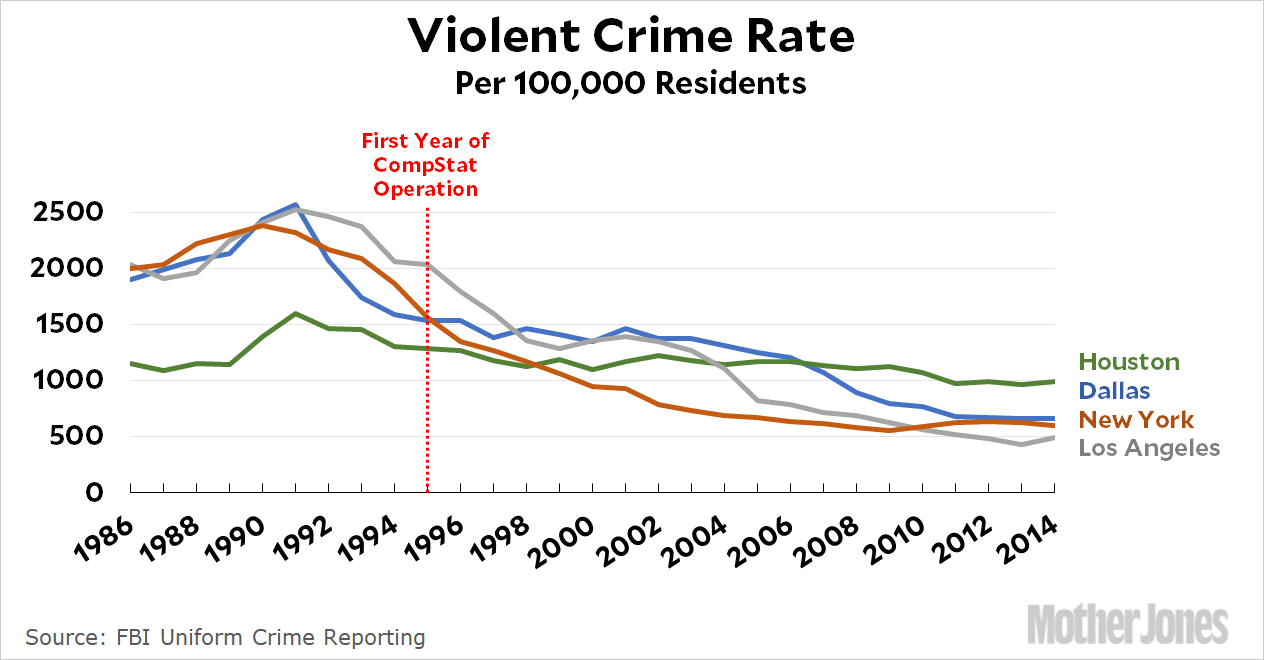
Reading this: Crime Didn’t Drop In New York City Because of CompStat, reminded me of Kevin Drum's complete and utter hypocrisy.

He makes the good point that the follow graph shows that crime began dropping well before NYC implemented a new computerized crime-tracking system.


However, he has many times claimed that James Comey's letter handed the 2016 election to Trump over Clinton, never acknowledging that Clinton began dropping in the polls well before the letter was released:


You can look at the original here: NY Times: A 2016 Review: There’s Reason to Be Skeptical of a Comey Effect.  I've posted this countless times on his site, but Drum hasn't acknowledged.  He's continued to repeat periodically that Trump won because of Comey.  (He's also blamed the Russians and Bernie Sanders, never acknowledged that he and other recipients of vast quantities of  Clinton campaign cash may bear some responsibility.)

Saturday, March 03, 2018

Our Newspaper of Record

This is a continuation of a subject we've been discussing for awhile.  Ongoing dialog over the course of years is a cool thing that you can do with friends.

Back in May, after the Times hired Bret Stephens, I sent you guys a link to this article:  SIX WAYS THE NEW YORK TIMES COULD GENUINELY MAKE ITS OP-ED PAGE MORE REPRESENTATIVE OF AMERICA.  As the author Zaid Jilani said:
Public Editor Liz Spayd responded to readers’ complaints about Stephens by writing that the Times is looking “to include a wider range of views, not just on the Opinion pages but in its news columns.”
But hiring another prominent writer whose ideology hems close to that of the nation’s elites — in this case, fossil fuel corporations who are polluting the world and advocates of Western military might — is hardly adding intellectual diversity to the pages of the Times.

Since then, I have read more complaints about the NY Times Opinion pages, and shared this recent article on the subject;   Leak: How NYT Editor James Bennet Justifies The Op-Ed Page To His Own Paper.  This article makes the point that not only do the Opinion writers lack diversity, but they are sometimes hacks who distort the facts.  Here is an example of this:
On Feb. 12, two days before the massacre in Parkland, Florida, Bennet’s section ran a piece titled “Background Checks Are Not the Answer to Gun Violence.” The author was John Lott, a man famous for distorting data to push the pro-gun agenda from which he makes his money. This would certainly seem like an astounding oversight from the paper of record.  On Feb. 17, however, a Times editorial included this paragraph: “In a speech last month, [Attorney General Jeff] Sessions said undocumented immigrants are far more likely than American citizens to commit crimes, a claim he found in a paper by John Lott, the disreputable economist best known for misusing statistics to suit his own ideological ends. In this case, it appears Mr. Lott misread his own data, which came from Arizona and in fact showed the opposite of what he claimed...

So the Times published an op-ed by a "disreputable economist best know for misusing statistics" (their words), although they don't acknowledge their mistake in publishing his op-ed.  I'm confident that I can find many more examples.  Remember, this whole conversation started in April 2017 when they hired Bret Stephens who questioned climate science in his first column, then was forced to correct the only line containing any reference to actual science three days later.

Now, in response to comment set #1:
  • "I’ve read the Bennet slam piece in HuffPost"The HuffPost article is just one of many reporting on the dissatisfaction.  Here is one from VanityFair:  “THE NEWSROOM FEELS EMBARRASSED”: BACKFIRES AND EXPLOSIONS AT THE NEW YORK TIMES AS A POSSIBLE FUTURE CHIEF RE-INVENTS THE PAPER’S OPINION PAGES
  • "Bennet has a thankless job.  Those of us who appreciate the page’s liberal bent like the result, in general.  But the white man predominance will cause much flack, for perhaps good reasons."
    The issue is lack of diversity in range of views, not in identity of writers.  As Glenn Greenwald says:
    If your goal were to wage war on media diversity in all of its forms, and to offer the narrowest range of views possible, it would be hard to top the roster of columnists the paper has assembled . . . literally every one of them fits squarely within the narrow, establishment, center-right to center-left range of opinion that prevails in elite opinion-making circles 
     
  • " 'Erosion of trust in what the NYT does'?  Oh please.  The news slant of the NYT and the slant of the op-ed page are basically together.  If you don’t like the slant, read or write for a rag of your persuasion.  Not enough people of color, women, women of color, etc.?  Of course. Not enough conservatives?  Of course.  The damn page has only so much space."
    • My friends and relatives read the the NYT.  So even though it is not my choice to read regularly, it is important to people I care about, and therefore matters to me.
    • The NYT is a newspaper of record, i.e. a major newspaper that has a large circulation and whose editorial and news-gathering functions are considered professional and typically authoritative.  Perhaps when a newspaper of record goes off the rails, societal problems follow?  The NY Times famously bungled the major issue of the 21st century, the 2003 war in Iraq, for example.
  • "If more diversity were wanted, I would suggest Bennet might consider adding Stephen Henderson, late of the Detroit Free Press (probably turfed out from the Freep more because he was too expensive than because he harassed a would-be girlfriend after his divorce) or Leonard Pitts of the Miami Herald.  Both African Americans but both, oops, of the same political/liberal persuasion as most of the guys on the current NYT op-ed page."I like both Henderson and Pitts, though I'm not sure if they would address the diversity of opinion issue.
  • "I happen to like Krugman, Brooks (usually), Friedman, Douthat, Bruni (gay guy), Kristof, Dowd, Blow, etc."I don't read any of these people except when someone has a problem with one of their articles.  So please feel free to share any of their articles which you think are good.  The writer I'm most familiar with is Krugman, and I've written about some of his mistakes as an economist:  Is Paul Krugman Ever Wrong?. 
  • " If the newsroom of the NYT feels embarrassed by the op-ed page, they might want to know that some of us who read the NYT read the op-ed page even before we read their stuff.  Their stuff is not 'fake news', and is well researched and well written, but in this polarized world, I want to see first what the whiners of my persuasion have to say about the messes in the world."
    I also read the "whiners of my persuasion" first, in general.  I just happen to have a different set of opinion writers that I follow.  My number one opinion writer at the present timehappens to be on an anti-NY Times kick.  According to his perspective, the NY Times is partially responsible for this moment of Trump.  One thing he points out is that the Times (along with the Washington Post) uses unnamed sources who are often government insiders.  They are sometimes fed false information, such as the infamous Judith Miller affair leading up to the war in Iraq.  Miller invoked reporter's privilege and refused to reveal her sources in the Central Intelligence Agency leak and spent 85 days in jail protecting her source, Scooter Libby. 
         
    Anyway, reasonable people can differ on who they trust to filter the news.  I used to rely more on NY Times columnists, but have migrated to others in recent years. 
  • "Grumpy Bill M. who is proud of what he’s saying"Everyone's entitled to his or her own opinion!  
In response to comment set #2:
one of the purposes of paper like the New York Times or the Washington Post is to take on major investigative efforts to root out and expose serious societal problems.  And, to express well-reasoned editorial opinions.  This is less likely to occur within the realm of blogs where personal opinions tend to drive the written word. I see the purpose of the New York Times as providing an enlightened viewpoint in the editorial pages, and a well-researched news analysis in the news sections. They won't be right all the time in the editorial portions of the paper, but they are worth supporting for the high frequency of getting it right.   These are both critically important functions to the ongoing process of a functional democracy (and we have reason to be concerned about the "functionality" of our democracy with a President such as Trump who seeks to undermine what our Constitutional democracy is about without really understanding what it is -- or should be -- in the first place).

That is very well said, in my opinion and fits in well with my comments above on the NY Times being a newspaper of record .  My perspective is a little bit different in that I see the Times and Post as being complicit in an ongoing basis with regard to our societal dysfunction.  They are pushing very hard to make the case that Trump is an aberration, whereas I feel that the Republican party has been off the rails for most of my lifetime.  

David Brooks provides a very clear example of this as a serious Republican who supported the war in Iraq and Sarah Palin, while repeatedly bashing Obama for not compromising enough with the Republicans in Congress.  See Obama in Winter:

White House officials are often misinformed on what Republicans are privately discussing, so they don’t understand that many in the Republican Party are trying to find a way to get immigration reform out of the way.

He also dismisses Sanders supporters such as myself as extremists comparable to neo-Nazis.    
The most important caucus formation will be in the ideological center. There’s a lot of room between the alt-right and the alt-left, between Trumpian authoritarianism and Sanders socialism.

Paul Krugman is the most liberal of the times columnists, and he likewise considered Sanders' policy positions, which basically represent the status quo in all other developed countries (e.g. universal health care) as too extreme.

Well meaning people want to believe in the country and the newspapers of record as anchors in an increasingly frightening world.  But anyone can see that the United States is far behind other developed countries in many measures of societal health -- poverty and income inequality, health care, education, the environment, guns, military and intelligence spending, etc. There is something wrong with a newspaper of record that considers a political leader who points this out as beyond the pale, while treating seriously the likes of Sarah Palin, Newt Gingrich, Paul Ryan, Mitch McConnell, and John McCain.  As Bill might say, the newspapers of record are in a difficult position given the powers behind the scenes in American society.  But I will thank them when they start getting things right according to my values.

Again, reasonable people can have differing opinions!  Thanks for the thoughtful responses.

Saturday, February 17, 2018

Why I Believe Russia-gate is Overblown (Dangerous, Delusional Russian Hysteria!!!)

The U.S. "Intelligence" agencies do not have a good track record

  • Mueller was part of the intelligence team making the case for the 2003 Iraq War:
Baghdad has the capability and, we presume, the will to use biological, chemical, or radiological weapons against US domestic targets in the event of a US invasion. 
 This was on of the two largest blunders of my lifetime (along with Vietnam), resulting in about 1 million unnecessary deaths.
Mistakes were made; hundreds of thousands of lives lost; U.S. credibility destroyed.  

The intelligencies agencies have a job to do, and that's fine.  But we the people need to form our own political judgments considering more than just the few pieces of evidence released by the intelligence agencies.

The Impact of the Russian Interference is being Greatly Exaggerated 

  • Leon Panetta, Director of the CIA as well as Secretary of Defense under President Obama, said yesterday that the Russian interference was equivalent to a physical bombing (can't find link, but I saw this on the NBC Nightly News).  His top assistant at the CIA, Jeremy Bash, described the episode as an event of "epic  proportions".  The mainstream media is unanimous in echoing the intelligence community's opinion that this is all as a very big deal.
  • The fact is, however, that the Russian effort is trivial in the big picture.  The U.S. routinely seeks to influence public opinion in other countries, including Russia, and on a much bigger scale.  Also, the total Russian operation is a drop in the bucket compared to the amount of money spent by U.S. sources.  And some of the Russian money was spent on other things, including funding anit-Trump rallies after the election. 
  • As Deputy Attorney General Rod Rosenstein emphasized at a Friday news conference:

    There is no allegation in this indictment that any American was a knowing participant in this illegal activity.  There is no allegation in the indictment that the charged conduct altered the outcome of the 2016 election. 

Let's Not Overreact Once Again

In matters of "national security", the U.S. public has been repeatedly whipped into a bi-partisan frenzy of support for aggressive military behavior and more military/intelligence power and spending.   I do agree that we should discourage the Russians and others from meddling in our elections.  But's let keep the big picture in mind.

The U.S., as a global superpower, has squandered credibility and the moral high ground since 9/11, by applying laws and logic selectively.  Practically, this attitude has brought us domestic chaos (the Trump Administration) and international skepticism.  Let's quit digging this hole by trying to blame Russia for Trump.  We're only fooling ourselves.

Monday, February 05, 2018

More Reasons We Need Sanders Wing Policies

Sanders' platform addressed several areas that have been problematic, and not addressed adequately by the Obama / Clinton wing of the Democratic party.

1. Financial Bubbles
Discussion at EschatonBlog :
Bubbles are the problem with the financial markets. Bursting them is painful, but better sooner than later. Bitcoin is the obvious current example, but the stock markets have been in severe bubble territory for some time.

But when bubbles do burst, it is problematic for everyone, whereas their inflation manages to benefit those with the most resources to get into markets.

Yes. That's one of the problems I've had with mainstream Dem, as well as Republican, policies. After dotcom and housing, we should have learned some lessons about these financial bubbles. I guess Dodd-Frank was better than nothing, but it hasn't prevented more potentially damaging financial bubbles.
2. Health Care and Tuition Inflation
Kevin Drum notes that tuition and medical expenses have risen much faster than the general rate of inflation in recent years.

Friday, February 02, 2018

Tuesday, January 30, 2018

The Service Economy and the Fallacy of Composition

Here's an article that makes some interesting observations, but doesn't give answers: Donald Trump, #MeToo, Facebook, And The Breakdown Of Institutional Power.  Excerpt:

Trump constantly subverted the expectation of what a normal candidate would do (e.g., apologize for accusing Judge Curiel of bias based on his Mexican-American heritage) by never conceding any mistake. The idea generally is that campaigns, like corporations, are basically built to apologize, walk back, and/or preemptively manage expectations so that the minimum number of voters take offense at any given thing. Trump rejected that framework entirely, but stretched the understanding of what was normal so far that there was a sense (a flame that apparently burns eternal) that some objective, imagined hand of authority — the Republican Party or the RNC or the delegates at the convention — would step in. No one did, because the uneasy reality is that candidates and their own campaigns alone govern the candidate and campaign’s conduct. If you’re unafraid of the public’s distaste, there are a lot of places you can run with that. Basically: If a candidate says, well, listen, I’m doing this and you can’t stop me — maybe you actually can’t. Trump, then, is like some classical Greek, Shakespearean character sent to reveal that weakness in the system.

And here's an article that takes the analysis in the previous article deeper, and points to the needed corrective action:  The Post-Physical Economy and the Rise of Trump. 

This second article spells out the logic which brought us to where we are today.  I'd like to quote the entire article here as it flows wonderfully, but I'll spare you and let you click on the link if interested.  Here's a relatively brief excerpt:

It’s a ridiculous idea, but one that’s pervasive to the point of cliché: the key is education. But even if there is a chance that, in isolation, an enterprising young person could improve his or her situation by getting more degrees, it might well be that if everyone headed in that direction, the economy would collapse entirely. There just can’t be an economy where nothing physical gets done, because everyone is sitting in a cubicle somewhere, managing, or thinking, or coding, or writing emails, or staring blankly at Facebook...
 
The mainstream political left, including Hillary Clinton and Barack Obama, put everything on this picture. It was Bill Clinton and Al Gore’s rallying cry in the 1990s: a bridge to the 21st century, a transformed IT America. With the technocratic vision comes a whole syndrome of positions: leaning on experts, relentlessly emphasizing science and technology, paying abject homage to software billionaires, creating a three-way circulation between Goldman Sachs, Harvard University, and the cabinet. Then Democrats wonder how they lost the blue-collar vote. If you think it’s in the interest of blue-collar people, for example union members, to help the Democratic Party transform the economy and the values of the culture in this way, you’re willfully blind, whatever government benefits you’re offering. I think it was much closer to their rational interest to vote for Trump.
 
One strategy for realizing this impossible vision of a post-physical economy might have been to promote all native-born Americans to service-providers or IT consultants while importing a workforce for practical matters such as agriculture, transportation, building, mowing lawns, and so on. There has been some of that; fundamentally, that’s where those 11 million undocumented people came from. But the basic move was to shift manufacturing and even to some extent agriculture to other countries. The only way to have something resembling a service or information economy, or a whole workforce of professionals and cubicle-dwellers, is to outsource physical reality more or less entirely...
 
We obviously will never be a planet of managers and code-writers, except as we verge on extinction. We’re still physical creatures in a physical environment.

We see something like Idiocracy at work already in society.  In that movie, humanity had moved to an overly automated society.  Humans had built a lot of great machines, but we couldn't maintain them properly.  The result was a mess.  Who among us has not marveled at the stupidity of our automated telephone customer services systems?  Occasionally, automation is a mistake.  In my opinion, the rush to automonous vehicles is in the same vein.  They won't work well enough to be worth the expense and frustration.  The autonomy and purpose we experience in controlling our vehicles may be more valuable than the time saved by very fallible robots.

At a larger level of abstraction, we can see the neoliberal Fallacy of Composition at work.  Just because it makes sense for individuals to strive for higher education and non-physical labor, doesn't mean that that is worthwhile and attainable goal for society at large.  Rather than all becoming artists and computer programmers, perhaps society is better off with people doing physical work.  Yes, physical work can be difficult and dangerous, but that doesn't mean that it is entirely inappropriate for humanity.  Use technology to make the work safer and more enjoyable, not to eliminate it entirely.  Driving is a good place to start.

Tuesday, January 09, 2018

Economics 101 (Money and Banking)

I majored in Economics at the University of Michigan, yet never learned the basics of banking and the monetary system used by the United States and all other countries.  This seems like a problem that can and should be corrected.  Wouldn't we be better served by economists who understood the monetary system, including topics such as government debt and banking that are part of everyday discourse?

I was just reviewing my own understanding of these subjects (which I acquired outside of college) and ran across this very good primer (at an MMT website):  Money & Banking.  Read this (also in textbook form here) and you'll know more about the subject than Paul Krugman.

Thursday, December 14, 2017

Higher Consciousness

Humans are programmed to survive, yet our survival looks doubtful because the very aggressive traits that have made us successful seem likely to cause us to destroy each other.  Perhaps there are two schools of human survival:

  • The moral school-- We need to move to a higher level of consciousness, where concern for the species overrides concern for individuals.  This has perhaps happened evolutionarily as humans consist of trillions of individual cells (and bacteria), yet we consciously value the human more than the component cells.
  • The survival of the fittest school-- Individuals need to kill off the competition from other individuals.  This doesn't seem practical to me as humans are social animals and no one can do much by him or herself.  The best that can be done in this regard is to be part of a group that is victorious over competing groups.  However, winning groups tend to be composed of individuals committed to the group, and so we are back to the need for a higher level of consciousness.
What is "God", if not a higher level of consciousness?  Religion may be irrational, but on the other hand there is an evolutionary imperative to get beyond individual consciousness. 

Monday, December 04, 2017

The NY Times likes Republicans and racist conservatives. Their "liberalism" is simply a marketing tool.

From Atrios:
I have no idea why the New York Times keeps elevating racist dumdums to the status of philosopher genius or why the fact that someone deemed worthy of such a portrait "reads books" is notable. He's super smart, and he reads books!
The Times has been doing this for years. At some point Occam's Razor applies in explaining why the Times covers things they way they do. They like Republicans. They like racist conservatives. Their "liberalism" is simply a marketing tool (not that I have ever really thought the Times was liberal over and above rich New Yorker liberalism which isn't really liberal, but their readers think it is).
 The link above is to this article, which is about as chilling an indictment as I have ever read, in which Nathan Robinson reviews Ben Shapiro's work, and wonders why the NY Times acts as if he's a serious intellectual.

Atrios has pointed out several other examples of this in just the last week.  Here's discussion of another example from
How to Interview a Nazi -- White supremacists should be challenged—not indulged:
balance is important. Nazis should not be ignored. They are dangerous. We need to understand where they’re coming from, what motivates them, and what their strategies are. Ignoring bigotry doesn’t make it go away. The basic principles of journalism still apply: They should not be misrepresented, lampooned, or caricatured. But neither should they be indulged. We should not inflate their importance, ignore their brutality, or enable their self-aggrandizement. They are not regular politicians. Violence is central to their method; exclusion is central to their meaning.  Instead, they should be confronted, challenged, and exposed. How we engage them—and why—is an issue of political morality. This is an imperative that sits uneasily with flaccid notions of journalistic objectivity...  You can’t weigh genocide against relatively stable democracy as though any reasonable person might disagree on the outcome... The Times article failed on most of these counts. Indeed, thanks to its obsession with the trivial details of the Hovaters’ daily lives, its effect was not to expose the obscenity of their views, but rather to underscore the normality of their existence. It offered this as a revelation, as though Hannah Arendt had never covered Adolf Eichmann’s trial...  This is essentially the same mistake that the British press makes every time it profiles a jihadi terrorist. The reporters marvel that the killer in question once supported Manchester United, ate fish-and-chips, drank in pubs, and had girlfriends.
I guess this latter case is really more incompetence on the part of the Times, as opposed to their really liking their Nazi subject.

Monday, November 27, 2017

Identity Politics and Ta-Nehisi Coates

Apparently, Ta-Nehisi book has a new book coming out, and he doubles down on identity politics.  Here's an advance rebuttal:  Racism May Have Gotten Us Into This Mess, But Identity Politics Can’t Get Us Out:
Coates takes it a step farther, casting those who focus on the role economic anxiety played in 2016 as disingenuous “apologists” who only emphasize class in order to avoid their own complicity... Coates is right to highlight how race affects the level of public sympathy for those who suffer...
Race is an important factor in this narrative, but centering it exclusively risks shifting focus away from those voter concerns that politicians can actually control. Personal prejudice, unfortunately, is not one of them.
Economic justice isn’t a panacea. Criminal-justice reform, immigration, and voting rights, for example, are all crucial progressive issues rooted in identity which would become less visible if we didn’t “see race.” But without a strong class-based argument, Democrats will be left to rely on the twin engines of demographic change and racial solidarity to win in the future. Unfortunately, neither is reliable.
Although identity can, at times, serve as shorthand for political views, it provides no more certainty than a stereotype. Racial groups are not monolithic — nor are their voting patterns written in stone. It is the height of hubris, for example, to assume that non-Hispanic immigrants and non-immigrant black Americans would be equally invested in immigration activism as are certain recently arrived Latinx communities...
My ultimate quibble with Coates’s piece is with its pessimism — the presumption that the union between rich and poor whites, forged in the heat of antebellum anti-black antipathy, is America’s destiny as well as its past.
And my follow up comments:

Basically, there have been two Democratic perspectives on why Trump won in 2016:
  1. Americans are racist.
  2. Americans wanted a change in the economic status quo.
Obviously, there is some truth in each of these perspectives.  Ta-Nehisi Coates, a highly respected African-American intellectual, seems to place more weight on racism as the determining factor.  Briahna Joy Gray, the author of the article I forwarded, places more weight economics as the determining factor.  As she says:

Barack Obama’s two campaigns are a powerful model for what a presidential pitch centering economics, rather than race, sounds like. As Michael Gerson, a speechwriter for President George W. Bush and Bob Dole observed, Obama’s 2012 stump speech was “very much an FDR Democratic class-warfare speech … He’s very much running on economic populist themes in tough economic times.” Highlighting class, Obama was able to win decisive numbers of white voters in crucial midwestern states. Despite his own identity, he won. Twice. Democrats should not let Trump’s racism drive them away from that effective strategy.

On Self-Driving Cars

The following observations are based upon the following article: https://www.nytimes.com/interactive/2017/11/09/magazine/tech-design-autonomous-future-cars-detroit-ford.html.  

Here's a passage that very well expresses my concerns:

A self-driving car has to correctly identify and label millions of objects, understand city layouts and traffic laws and operate in a variety of road conditions. It has to be taught to handle everyday driving hazards (high-speed merges) and rarer incidents (objects in the road), as well as issues that would never affect a human driver (a chunk of debris that flies up and knocks out a sensor).
 
In order to work properly, a self-driving car also has to understand how humans behave. It needs to know the difference between a car that is idling in the right-hand lane (in which case the autonomous vehicle should steer around it) and one that is about to parallel park (in which case the vehicle should stay in its lane, giving the other car some room). It needs to predict that the jogger running toward the corner will stop for traffic, but that the kid running to chase a basketball might not. It needs to be able to navigate a four-way stop, which in polite parts of the country involves lots of eye contact and you-first hand gestures. “This goes beyond just seeing and understanding the world,” Salesky said. “It means understanding what each of the actors in the world is going to do.”
 
In other words, driving isn’t just a mechanical task — it’s a social act, and in order to coexist with human drivers, self-driving cars will need to develop a level of social awareness

I'm dubious that they'll be successful with a flat out migration from the current system to a system dominated by autonomous vehicles.  Rather, Ford has it right as described in the article:

Ford, in particular, believes that the first generation of driverless cars will be limited, capable of traveling only in commercial fleets inside carefully plotted urban areas. Other cars will simply get smarter without being autonomous, with features like collision prevention and self-parking becoming more common. Self-driving technology will eventually be more sophisticated and will one day be capable of full door-to-door autonomy in every possible area and condition, but as Ford sees it, that’s not going to happen overnight, or even very soon.

As cars gradually get smarter, the nation's transportation infrastructure will adapt and eventually enable a constrained autonomous driving experience.

Worldview

 I haven't been posting much here of late because I prefer writing in Google Docs. I've been linking most of my great thoughts into ...